
Examples of minimal viable websites for entrepreneurs
You do not need a polished, feature-rich website to start proving your idea works. The industry term for this approach is a minimum viable product (MVP) website, and the examples of minimal viable websites that have shaped modern businesses are far simpler than most entrepreneurs expect. Budget pressure, time constraints, and the fear of building the wrong thing entirely are real obstacles. This article cuts through the noise with real-world MVP examples, a comparison of the main types, and practical guidance on building something lean that actually validates your idea.
Table of Contents
- Key takeaways
- Examples of minimal viable websites: what makes them work
- Real-world minimal viable product websites that changed industries
- Comparing the main types of minimal viable websites
- Practical tips for building minimal viable websites on a budget
- My honest take on minimal viable websites
- Ready to launch your minimal viable website?
- FAQ
Key takeaways
| Point | Details |
|---|---|
| One clear action wins | Every effective minimal viable website centres on a single call-to-action that tests one core assumption. |
| Real MVPs are remarkably simple | Airbnb, Dropbox, and Zappos all launched with stripped-back websites that would embarrass most designers today. |
| Performance matters from day one | A 14 KB landing page renders faster than most polished sites and converts just as well. |
| Choose your MVP type deliberately | Landing page, concierge, and Wizard of Oz MVPs each suit different stages and budgets. |
| Budget constraints are an advantage | Fewer resources force clarity, which is exactly what a minimum viable website needs to succeed. |
Examples of minimal viable websites: what makes them work
Before looking at specific examples, you need a clear picture of what separates a functional minimum viable website from a half-finished one. The fundamental goal of an MVP website is to test whether a market exists and whether your idea meets a real customer need. That is it. Nothing else.
Here is what every effective minimal viable website has in common:
- One value proposition. A single, clear sentence that tells visitors what you do and why it matters to them.
- One call-to-action. Sign up, join the waitlist, or book a call. Not all three. One.
- Minimal JavaScript. Most landing pages carry 76% of their total weight in images and JavaScript. Cutting these yields enormous speed gains.
- Optimised images. Compress everything. Use modern formats like WebP. Load only what is visible above the fold.
- Semantic HTML and basic meta tags. Proper markup costs nothing and gives you baseline SEO from day one.
- A budget-conscious tech stack. For fewer than 100 users, your MVP stack essentials are a domain, authentication, a lightweight database, and payment processing. Most services stay on free tiers at this scale.
Pro Tip: Resist the urge to add a blog, a testimonials carousel, or an FAQ before you have a single paying customer. Every extra element is a distraction from the one question you are trying to answer: will someone pay for this?
Real-world minimal viable product websites that changed industries
These are the examples worth studying. Not because they were beautiful, but because they worked.
Airbnb’s first room-booking page
The original Airbnb website was a basic page with photos of an air mattress in a San Francisco flat and a simple booking form. There was no map integration, no verified reviews, no instant booking. The founders manually coordinated every reservation. What the site did brilliantly was communicate one idea clearly: rent a spare room to travellers. That single page validated the concept before a single line of scalable code was written.
Dropbox’s video MVP
Dropbox did not launch with a working product at all. They published a three-minute explainer video showing how the software would work. Overnight, their waitlist grew from 5,000 to 75,000 sign-ups. The website itself was a landing page with a video and an email capture field. This is one of the most cited successful MVP examples precisely because the “website” was the product validation.
Zappos and the Wizard of Oz approach
Nick Swinmurn photographed shoes in local shops, posted them on a basic website, and waited. When someone ordered, he bought the shoes at full retail price and posted them. There was no warehouse, no inventory system, no fulfilment infrastructure. The website simply had to look credible enough for someone to click “buy.” This Wizard of Oz approach tests product-market fit and customer behaviour without full engineering investment, and it remains one of the most instructive examples for any entrepreneur selling physical goods.
Landing page MVPs for demand testing
A landing page MVP is a single web page that explains an idea and asks visitors for one clear action, most commonly joining a waitlist. Dozens of successful SaaS companies launched this way. The page describes the problem, the proposed solution, and asks for an email address. If nobody signs up after real traffic hits the page, you have learned something priceless before spending months building.
SEO-ready one-page templates
For entrepreneurs who want to capture organic search traffic from day one, SEO-friendly one-page templates with proper semantic markup, meta tags, and social cards serve as excellent minimal viable website examples. They are mobile-first, fast-loading, and give you a foundation to iterate on rather than starting from scratch.
“An MVP is not about fewer features. It is about testing the riskiest business assumption with the minimum effort to learn.” — Refact MVP Guide
Comparing the main types of minimal viable websites
Not every MVP website suits every situation. The table below helps you match the right type to your current stage and budget.
| MVP type | Development cost | Time to launch | Best for | Main limitation |
|---|---|---|---|---|
| Landing page | Very low | 1 to 3 days | Demand validation, waitlist building | No product interaction for users |
| Concierge MVP | Low | 1 to 5 days | Service businesses, consulting | Does not scale; relies on founder time |
| Wizard of Oz | Low to medium | 1 to 2 weeks | E-commerce, marketplace concepts | Manually intensive behind the scenes |
| Single-feature product | Medium | 2 to 6 weeks | SaaS, apps with one core function | Requires some real development work |
The four main MVP types differ by cost, speed, and validation focus. A landing page MVP suits you if you have not yet built anything and want to test demand. A concierge MVP works well for service businesses where you personally deliver the service to early customers before automating it. The Wizard of Oz approach is ideal when your product appears automated to users but is actually manual behind the scenes. A single-feature product MVP makes sense once you have confirmed demand and need users to interact with a real, working feature.
The decision comes down to one question: what is the riskiest assumption you need to test right now? Build the minimum thing that answers it.
Practical tips for building minimal viable websites on a budget
Getting a minimum viable website live does not require a large budget or a development team. Here is a practical approach that works.
-
Start with a free or low-cost domain. Registrars like Namecheap or Google Domains offer .com domains for under £10 per year. A credible domain name matters more than the platform you build on.
-
Use a static site or no-code builder. Tools like Carrd, Webflow, or even a plain HTML file hosted on GitHub Pages or Netlify get you live in hours. Marketing pages can realistically ship at around 14 KB by avoiding complex JavaScript frameworks and large images.
-
Add authentication only when you need it. Services like Supabase or Firebase offer free authentication tiers. Do not build a login system before you have users who need one.
-
Integrate payments from the start if you are selling. Stripe is the standard choice. It handles compliance and security so you do not have to. For MVP-scale operations, payments are typically the only recurring cost beyond your domain.
-
Write copy before you design. The words on your page do more work than the colours or fonts. Write your headline, subheadline, and call-to-action first. Then design around them.
-
Use an SEO-ready template. A one-page template with proper heading structure, a meta description, and an Open Graph image gives you a meaningful head start in search without any additional effort.
-
Measure one thing. Set up a free Google Analytics or Plausible account and track a single conversion event: did the visitor complete your call-to-action? Everything else is noise at this stage.
Pro Tip: When designing minimal websites, treat every element you consider adding as guilty until proven innocent. Ask: does this help the visitor take the one action I want them to take? If not, remove it.
My honest take on minimal viable websites
I have worked with enough early-stage businesses to say this plainly: the biggest mistake I see is not launching too early. It is launching too late, with too much on the page.
Entrepreneurs spend weeks agonising over colour palettes and font pairings while their core assumption, whether anyone actually wants this, sits completely untested. I have seen businesses spend thousands on polished websites for products nobody wanted. And I have seen a single, ugly landing page with a working email capture generate enough waitlist sign-ups to attract early investment.
What I have learned is that the best minimal viable websites are not minimal because of a lack of effort. They are minimal because the founder was disciplined enough to resist adding things. That discipline is genuinely hard. Every stakeholder, every advisor, every well-meaning friend will suggest something to add. Your job is to say no until the data tells you otherwise.
The aesthetics matter less than you think at this stage. Performance matters more than you think. A page that loads in under a second on a mobile connection will outperform a beautiful, slow page every single time. Iterative improvement is not a compromise. It is the strategy.
— Scott
Ready to launch your minimal viable website?
If you are at the stage where you know what you want to test but are not sure how to get it live quickly and credibly, Off and On Web Design builds exactly this kind of site. Clean, fast, mobile-first websites designed for small businesses and early-stage ventures, with no long-term contracts and no hidden fees.
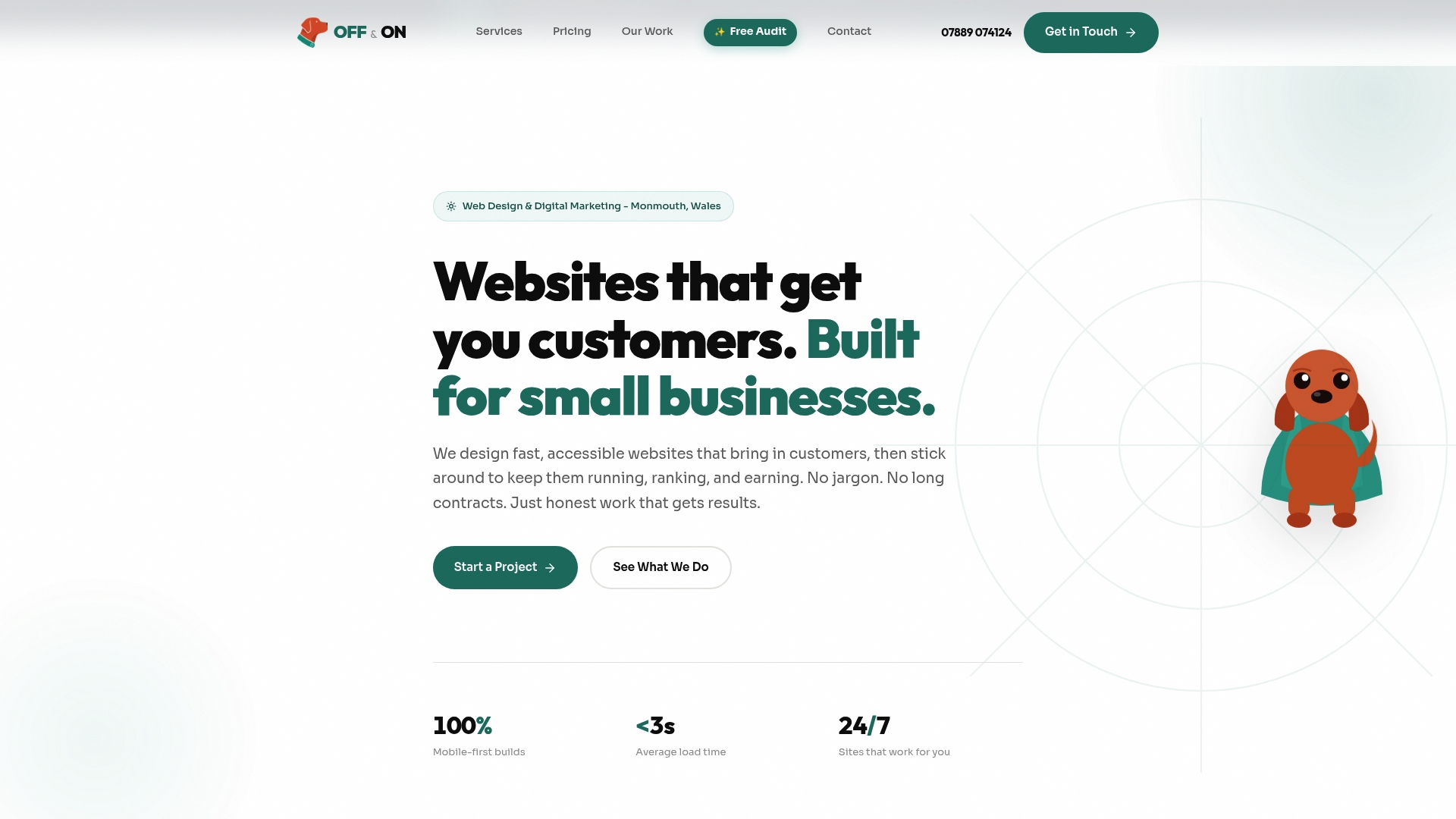
Browse the portfolio of work to see how lean, effective websites look in practice. Then check the transparent pricing options to find a package that fits where you are right now. Off and On Web Design works with startups, tradespeople, and local businesses who need a site that actively drives enquiries, not just one that looks good in a screenshot.
Get started with Off and On and put your idea in front of real customers sooner than you think.
FAQ
What is a minimum viable website?
A minimum viable website is the simplest version of a web presence that tests one core business assumption with real users. It typically includes a single value proposition, one call-to-action, and minimal design elements to maximise speed and clarity.
How much does it cost to build a minimal viable website?
Most minimal viable websites can be built for under £50 per month, with the domain and payment processing being the primary costs. Many platforms offer free hosting tiers suitable for early-stage validation.
What are the best examples of minimal viable websites?
The most cited examples include Airbnb’s original room-listing page, Dropbox’s video landing page, and Zappos’ basic product page backed by manual order fulfilment. Each validated a major business assumption before significant engineering investment.
How long does it take to launch a minimal viable website?
A landing page MVP can go live in one to three days using no-code tools or a static HTML template. More complex Wizard of Oz or single-feature MVPs typically take one to two weeks.
Do minimal viable websites rank on Google?
Yes, if they include proper semantic markup, a meta description, and mobile-first design. SEO-ready one-page templates with these elements in place can begin ranking for relevant terms shortly after launch.